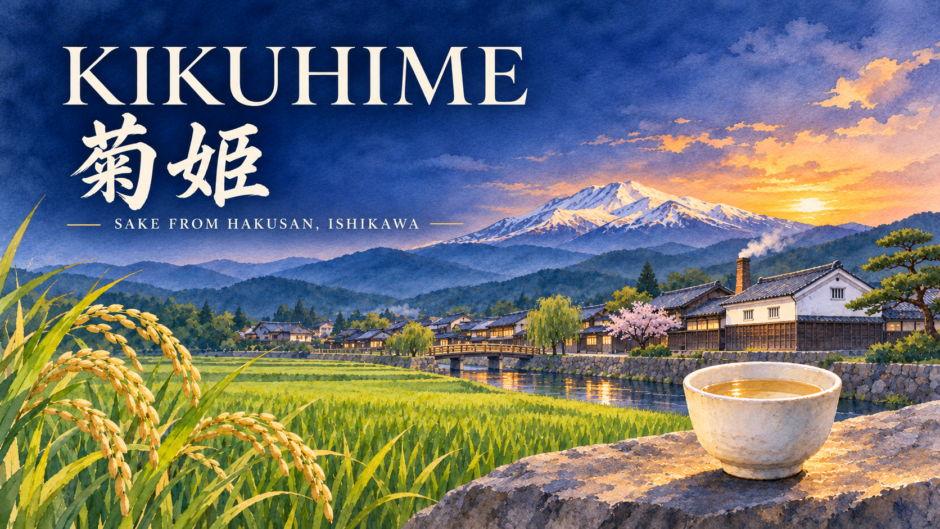

Kikuhime (菊姫) is a sake brewery in Tsurugi, Hakusan City, Ishikawa. One useful way into its range is Yamahai Junmai (山廃純米), a rich expression whose character is tied to its fermentation starter and maturation. A second product, Tsurunosato (鶴乃里), shows how the same brewery can approach yamahai in another way.
Kikuhime at a glance
| Japanese name | 菊姫 — Kikuhime |
|---|---|
| Producer | Kikuhime Co., Ltd. (菊姫合資会社) |
| Location | Tsurugi, Hakusan City, Ishikawa Prefecture |
| Main focus | Yamahai Junmai — 山廃純米 |
| Also introduced | Tsurunosato — 鶴乃里 |
| Useful label word | 山廃 — yamahai, a fermentation-starter method |
What does yamahai tell you?
Kikuhime explains yamahai as a way of developing the yeast starter, called shubo. Its description emphasizes the interaction of yeast and lactic acid bacteria, and connects that process to acidity and a substantial taste.
The term is therefore about how the sake is made. It does not mean that every yamahai tastes identical, nor does it automatically tell you the serving temperature or alcohol content. The exact product still matters.
Yamahai Junmai: richness and maturation
The producer says this product was released in 1983. It describes nutty and caramel-like aromas, firm acidity and substantial rice umami. Its listed maturation period is one to two years, giving readers another clue to the intended style.
| Product | Yamahai Junmai — 山廃純米 |
|---|---|
| Rice | Yamada Nishiki from Yoshikawa, Miki, Hyogo’s Special A area |
| Rice-polishing ratio | 70% |
| Starter | Yamahai |
| Listed maturation | 1–2 years |
| Alcohol | 16% |
These figures belong to the standard Yamahai Junmai. A 70% rice-polishing ratio means 70% of the original grain remains after polishing; it is not a rating of quality.
Tsurunosato: another expression to recognize
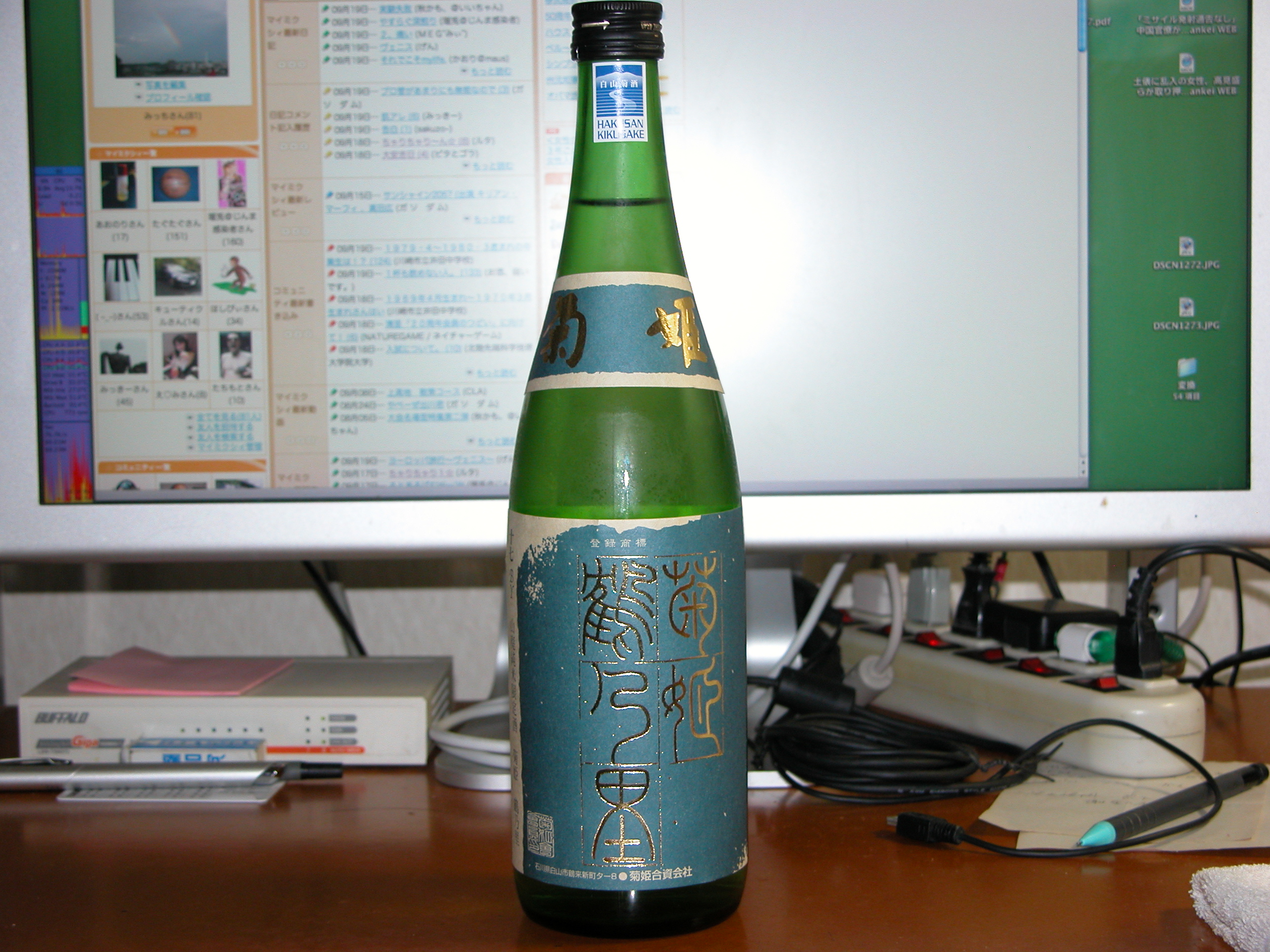
Tsurunosato is the product shown in the historical photograph above. Kikuhime lists Yamada Nishiki rice polished to 65%, a yamahai starter and 16% alcohol. The brewery describes it as combining strength with finer umami.
The producer also identifies Tsurunosato as the first Champion Sake when the International Wine Challenge introduced its sake division in 2007. That is an award for a particular product and occasion, rather than a ranking of all Kikuhime sake today.
Do not confuse the standard bottle with nama genshu
Kikuhime separately lists Yamahai Junmai Muroka Nama Genshu, a winter release bottled without filtration or heat treatment. Its official specification is 19% to under 20% alcohol, and it requires refrigeration. That is materially different from the 16% standard Yamahai Junmai above.
If you see 無濾過生原酒, read the bottle’s storage guidance carefully and confirm which release you are buying. The shared 山廃純米 wording does not mean the two products have the same strength or handling requirements.
How to begin exploring
For a first purchase, identify the full Japanese name and ask the retailer for the exact product’s serving guidance. As an editorial pairing idea for the rich standard expression, try a small pour with a savory dish such as mushrooms or a miso-seasoned preparation. This is a starting experiment, not a brewery-verified pairing or a personal tasting claim.
Compare aroma, acidity and finish separately. Those observations will tell you more about your preferences than deciding whether you like every sake described as yamahai.
Explore more Japanese sake
Compare these stories with Masumi (真澄) and its No. 7 yeast heritage, Kiku-Masamune (菊正宗) and cedar-scented taru sake, or Shinkame (神亀) and aged junmai.
Sources and further reading
- Kikuhime — brewery location
- Kikuhime — Yamahai Junmai
- Kikuhime — Tsurunosato and its 2007 award
- Kikuhime — Yamahai Junmai Muroka Nama Genshu
Information checked November 6, 2026. Product specifications and availability may change. Tasting descriptions are attributed to the producer rather than based on a tasting conducted for this article.