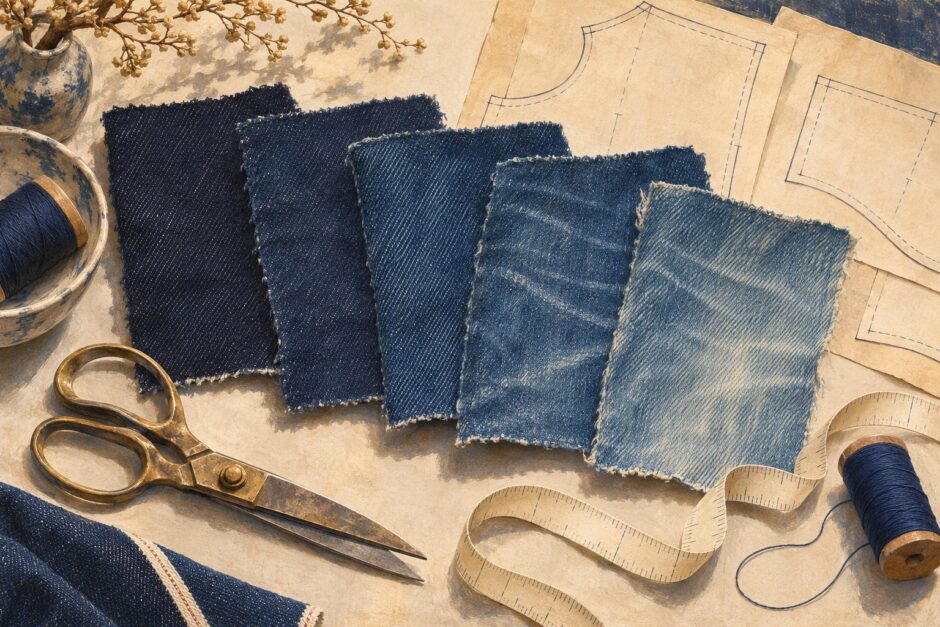

STUDIO D’ARTISAN(ステュディオ・ダ・ルチザン) is a Japanese clothing brand founded in Osaka in 1979. Its jeans connect vintage workwear ideas with Japanese textile craftsmanship. A useful introduction is the SD-101: a regular straight model built around substantial 15oz denim, a button fly and blue selvedge.
If your interest in Japanese denim goes beyond a logo, this is a brand worth exploring through the fabric itself. The questions are practical as well as historical: how does it fit, what happens when it is washed, and which version should you choose?
STUDIO D’ARTISAN at a glance
| English name | STUDIO D’ARTISAN |
|---|---|
| Japanese name | ステュディオ・ダ・ルチザン |
| Brand origin | Osaka, Japan; established in 1979 |
| Background | Vintage-inspired Japanese denim; part of the group known as the Osaka Five |
| Model in this guide | SD-101 15oz Regular Straight |
| Key buying decision | Unwashed or one-wash, then fit and measurements |
A brand that began with a shop
The brand’s official history starts with M’ARIJUAN, a shop in Osaka’s Shinsaibashi area during the late 1970s. Its owner had studied clothing in France and collected vintage jeans. That interest developed into a desire to make jeans in Japan.
In 1979, he launched STUDIO D’ARTISAN, a name the brand explains as “artisan workshop.” The official account describes the effort involved in studying old jeans—their sewing, fabric and thread—at a time when the shop lacked the equipment and know-how needed for the project.
Today, the brand’s English introduction places it within the Osaka Five movement and describes an Okayama workshop using older weaving and sewing equipment. Osaka is the brand’s origin; Okayama is part of its production story. Keeping those places distinct helps make sense of Japanese denim labels.
Meet the SD-101 regular straight
The official store calls the SD-101 its basic original straight model. Its 15oz denim is woven on vintage shuttle looms, with a deep color and a sturdy feel. The product description says fading takes time, with whiskers and creases becoming distinct through wear.
| Model | SD-101 |
|---|---|
| Cut | Regular straight |
| Denim weight | 15oz |
| Details | Button fly, copper rivets, goat-leather patch and blue selvedge |
| Wash options listed | Unwashed and one-wash |
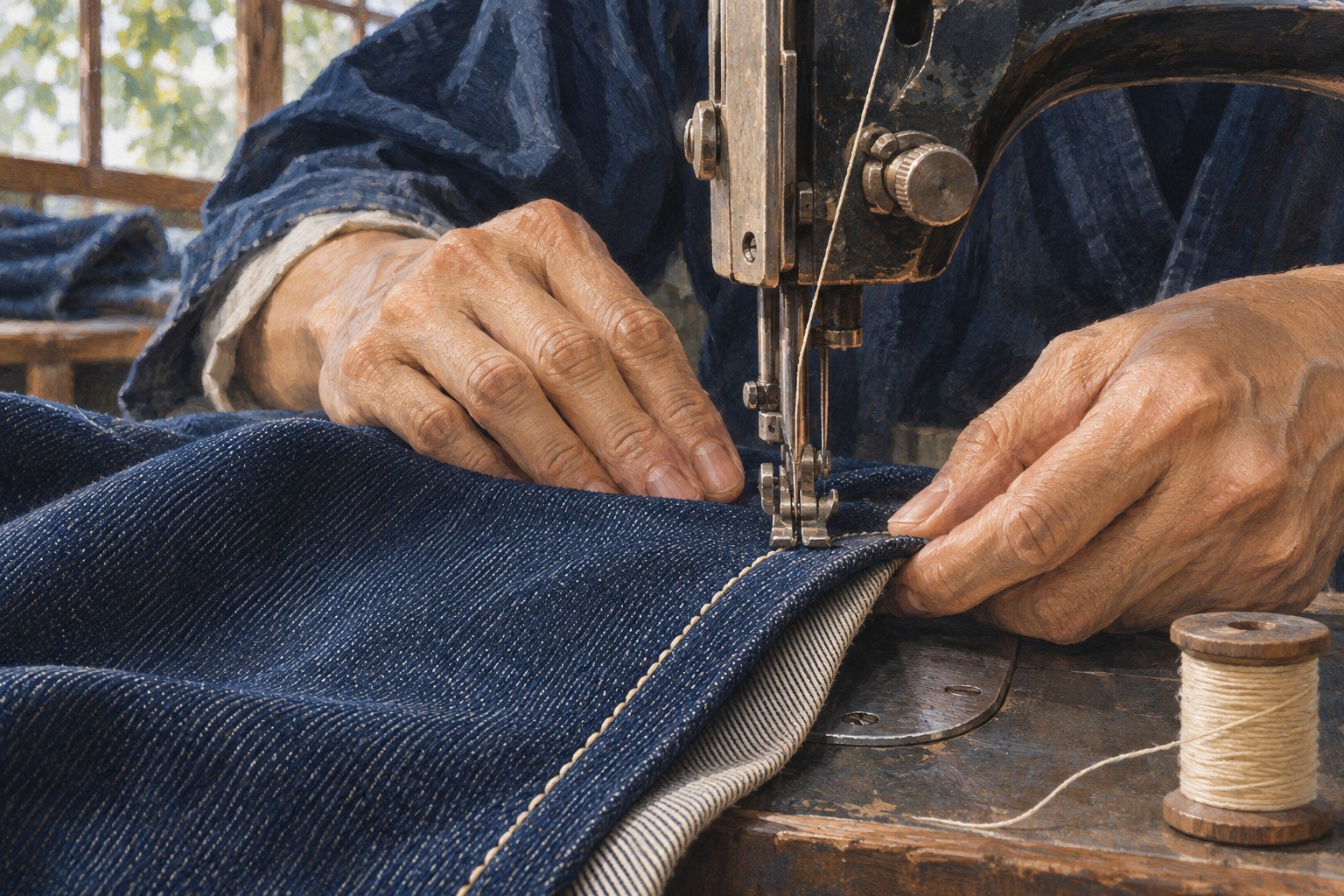
The fabric is not sanforized or given an anti-skew treatment. The manufacturer therefore describes shrinkage and twisting after washing as part of its vintage-style behavior. This matters when choosing a size and deciding when to have the legs hemmed.
Unwashed or one-wash: which should you choose?
The official SD-101 listings offer both options. Their size tables are identified as measurements after one wash, rather than measurements of the unwashed garment.
- Unwashed: choose this if you want to handle the initial washing process yourself. Ask the seller how much shrinkage to allow before settling on size and inseam.
- One-wash: a useful option if you prefer to compare a washed garment with the published measurements. It does not mean that all future dimensional change is impossible.
Do not choose only by the number on the waistband. Compare waist, rise, thigh, hem width and inseam with a pair that fits you well, following the seller’s measuring method. If you are between sizes, ask about the exact wash option and current stock rather than relying on a size recommendation for a different model.
The international store also states that hemmed items cannot be returned or exchanged. Resolve fit and shrinkage questions before requesting alterations.
Japan price guide
On November 6, 2026, the official Japanese store listed the standard SD-101 at ¥30,580. Separate SD-101-B01 and SD-101-B02 listings for larger sizes were ¥33,000 for 38/40 inches and ¥35,200 for 42/44 inches respectively. These are listed Japanese-store prices; shipping and overseas checkout totals can differ.
Check the SD-101 at the official Japanese store →
Read the official English SD-101 product information →
How to enjoy the jeans over time
Choose a fit you can comfortably wear in normal life, then follow the instructions supplied with the garment. The brand’s official store discusses washing, repairs and chain-stitch hemming as parts of caring for denim over time. Its washing introduction explicitly recognizes that there is no single correct approach.
That leaves room for personal preference. You might enjoy visible creases and contrast, or simply want a dependable straight pair that gradually softens. Treat dramatic fade photographs as examples of someone else’s wear, rather than a guaranteed result.
Another Japanese denim story to explore
For a different starting point, read our MOMOTARO JEANS(桃太郎ジーンズ)guide, which introduces Kojima origins and TOKUNO BLUE. Compare the individual models’ fabric, finish and measurements when choosing between them.
Sources
- STUDIO D’ARTISAN — official brand history and production background
- Official brand history — Episode 1, published October 21, 2014
- Official international store — SD-101 specifications and sizing
- Official Japanese store — SD-101 and Japan price
- Official Japanese store — SD-101-B01, sizes 38/40
- Official Japanese store — SD-101-B02, sizes 42/44
- Official international store — care and collection introductions
Information and prices checked November 6, 2026. This is a researched brand guide, not a hands-on wear test. Check the seller’s current specifications and conditions before ordering.